Thursday, August 11, 2011

Fun-ky, Fun-ky

There's one thing Ryan and I learned at FujiRock...you can never be TOO colorful here. Japanese hippies and concert-go'ers wear some of the brightest clothes I've ever seen, and I've been loving every minute of it! Unfortunately during the festival most people were wearing ponchos and rainboots (both of which were also pretty cool looking), and I didn't get many photos. But we did go into an Oshman's when we got back to Tokyo, and brands like Gramicci, ArcTeryx, Gregory, and Patagonia, are making clothes for the Japanese market that are NOT available in the U.S...and that's a sad thing for everybody back home.
~~~~~~~~

Crazy leggings are a staple in everyone's outfit, and they're not just for girls! 


Everybody loves fanny packs over here, and every time I go into one of these stores I almost break down and get one because they're so cool. But Ryan strongly disagrees with this fashion obsession of mine...what do YOU think though!?!?


Seriously awesome raingear.

Wednesday, August 10, 2011

Fuji Rockin'

We made it to Japan! And what better way to kick off our trip in Asia than do what we love most...see live music.

Fuji Rock is an annual 3-day music festival held at a ski resort in the mountains a couple hours outside of Tokyo. We got there by taking the bullet train from Tokyo (too bad we have to travel half-way around the world to experience modern-day transportation technology!) and then a quick shuttle bus organized by the festival. This was a nice change from taking a full day or longer road trip followed by hours sitting in traffic to get to music festivals in the U.S., that's for sure.


It rained most of the weekend, which was unfortunate because we were sleeping in a cheap ($25) tent that we picked-up at Wal-Mart before leaving the U.S., and by the first night most of our things inside were soaking wet. Ryan and I fashioned a sturdier rain fly with a tarp and some other bags the next day, and while it was probably the most pathetic looking tent at the festival, it did the job.


The whole weekend was wet and muddy and needless to say, a little uncomfortable. But the music made up for it all. We saw some great bands at the festival - some of our favorites that we've seen many times before (New Mastersounds, Widespread Panic and Dark Star Orchestra), and plenty of new stuff from Japan and elsewhere that we got to check-out for the first time.

Here's a little review with some video clips from the internet (not taken by us).

Coldplay was the opening night headliner, and they sounded good. With an enormous crowd and a big well polished performance, it had a stadium concert feel to it - something we're not very used to but enjoyed. 

New Mastersounds
This jazz-funk band from Leeds, England, one of our favorite groups, played two nights at the festival. Both sets were pretty short (~ 1 hour), but this isn't the kind of band that needs three hours to show you what they've got. A highlight was the second night when they were joined by a four-piece horn section from another funk band (didn't catch their name) that played earlier in the weekend.


Amadou & Mariam
This is a well known group from Mali, described on their website as "music for the world" with "roots deeply planted in Africa", that we saw for the first time and we were really impressed. Amadou is a real solid guitar player, as you can see towards the end of the video clip below.


Dark Star Orchestra
The Grateful Dead tribute band closed out the Field of Heaven stage the last night of the festival with two sets totaling almost four hours. It was their first and only time playing in Japan, and they didn't hold anything back, playing an incredible set list full of Dead favorites such as Terrapin, Shakedown, Help>Slip>Frankin's, China>Rider, St. Stephen, and Eyes of the World. It was so much fun seeing Japanese Grateful Dead fans digging the music. They refused to leave after the show was over, which you can see in the photo below (if you look closely, you can see us!).


Tokyo Ska Paradise Orchestra
This band, which has been on the Japanese music scene for over 20 years, describes themselves as an "eclectic mix of traditional ska, jazz, and rock". This is a great party band!


Sakerock
A Japan-based jazz-rock band - all really talented musicians. It was cool to see the trombone featured so prominently.


Some other bands that we enjoyed were Ra Ra Riot, Beach House, Cornershop, the Kimonos and Digitalism. A few bands that didn't get a chance to see but wished we did include Wilco, Soil & "Pimp" Sessions, Washed Out, the Middle East, and Reggaelation Independence.


Monday, August 1, 2011

Photos from the Brazilian coast and Rio

Paraty and Ilha Grande


The streets of Paraty are often flooded during high tide


Popular soda in Brazil (also a good vodka complement!)


Rio de Janeiro

Jenny's new Brazilian boyfriend


Ipanema beach


Views of a favela with Sugarloaf mountain in the background


The SelarĂ³n steps. We got to meet the artist, whose studio is right off of the steps...he's quite a character.


Sunday afternoon street party and samba at the corner liquor store!


About half of all cars in Brazil are fueled by ethanol (whether or not that's a good thing is a whole different and highly debatable matter!)


Rio at night
Samba at Rio Scenarium, a Rio institution in Lapa


Street party in Lapa


Out for a night of Samba with our Canadian friends Dani and Steve


More photos here.

Friday, July 22, 2011

Sao Paulo is cool

This might not seem like a breakthrough revelation, but after what we heard from both some Brazilians contacts that we spoke with and other travelers that we've met along the way, we were under the impression that Sao Paulo is just another huge city and not really worth visiting. We were told that it's the best place in Brazil to find a good job, but not too interesting of a place, and most travelers that we met that visited Brazil seemed to skip this city all together.

So following this advice, we planned not to spend much time in Sao Paulo. We didn’t stay long, but were pleasantly surprised and had a great time. The part of the city where we stayed (Magdalena) had a great vibe going on – with lots of cool restaurants, cafes, bookshops, bars and music venues. The locals that we met were also real friendly.

Traveling this year without much of a plan, we often rely on the advice of other travelers that we meet along the way as we decide where to go/what to do next. This was a good reminder that when people tell us that a place or activity is nothing special, sometimes you just need to check it out and decide for yourself. Or, could it be that because others told us that it wasn't that cool of a city, we actually liked Sao Paulo more than we would have otherwise? Maybe this really should be a reminder not to underestimate the power of expectations!

In Sao Paulo we saw some good live music, attended a soccer match, and are really glad we stuck around for a couple of days. We don't have many photos, but here are a few...

---
These guys were playing traditional samba music at a mostly empty bar in the afternoon, which was probably why they felt comfortable inviting me to sit in on percussion!


Funk band playing at a club right next to our hostel

Enjoying post-show late night noodles. Yum

Sunday, July 17, 2011

Border crossing

We decided to take the overland route from Bolivia into the Pantanal region of Brazil. To do this, we took a long overnight train, known as “el tren de muerte”, which translates to “death train” to get to the Bolivia-Brazil border. Despite the name, the train isn’t really dangerous or scary. We were told that there was once a serious Yellow Fever epidemic in Bolivia, and this train route was used to transport the bodies, hence the name.

While Peru and Bolivia are similar in a lot of ways, everything about Brazil felt different, especially in the area of economic development. Better infrastructure, more modern cities, cleaner/safer water and food, etc. Brazil is one of the fast growing and up-and-coming economies in the world, and you could tell. In international economic and political circles, you often hear countries described as either “developed” or “developing”. But after traveling from Bolivia into Brazil, these distinctions seem to be pretty misleading for a country like Brazil, which is generally referred to as a developing country. Compared to a country like Bolivia, Brazil to me seems to be in a totally different league. I’m sure the same could be said about other countries, such as China. There needs to be a middle classification for these rapidly advancing countries.

Other random things stood out to us about Brazil:

-Brazilians really know how to have a good time. Where else do you find mobs of people dancing on the street on a Sunday afternoon for no apparent reason or special occasion?

-People seem to take fitness pretty seriously in Brazil, with lots of gyms, runners, bike riders and of course, soccer. This culture of fitness seemed to be totally absent in Peru and Bolivia. (Having said that, we did meet people in Peru who had to hike four hours just to get to the nearest town, and they seemed to do this on a pretty regular basis like it was nothing!)

-Brazil’s surprisingly really expensive. After traveling in Bolivia, most places would feel pricey, but we weren’t expecting NYC/SF-level prices, even outside of the big cities that we visited. 

-Decent coffee. More often than not, we came across instant coffee in Peru and Bolivia (the coca tea made up for this).

-Rice and beans - woohoo!

Our first week in Brazil was spent in the Pantanal, the world’s largest wetland, located South of the Amazon rainforest in Western Brazil, and a town near the Pantanal called Bonito. After spending a month and a half in the mountains of Peru and Bolivia, it was a shock when we arrived in the hot, muggy and mosquito infested climate of the Pantanal. We saw insane amounts of birds (it is a wetland, after all, which is where birds like to hang out) including macaws, toucans, egrets and parrots. We also saw river otters, capybaras (large, hairy rodents), and lots of caiman (small crocodiles, similar to alligators). The Pantanal has one of the largest jaguar populations of North and South America, however much to our dismay we didn't see any on our trip. Apparently the crew from 60 Minutes had a lot more luck than we did in spotting jaguars. They just aired a segment on the jaguars of the Pantanal, which includes some great footage of both the jaguars and the Pantanal in general.

One afternoon we went on a safari hike that qualifies as both our best story from the Pantanal and the most uncomfortable/least fun experience. Hiking through knee-deep swamp water we spotted a caiman just a few feet away from us, and then moments later we saw a highly poisonous snake also just a few feet away.

Bonito, a town know for having rivers with some of the clearest water in the world, was cool place to visit. The rivers are clear because this area has a lot of limestone in the ground, which acts as a natural filter. We went on a snorkeling trip on one of these rivers, which was really different from other snorkeling we’ve done because they gave us life jackets and we just floated on down the river without really needing to swim or move at all.

-----
The journey to Brazil began with an overnight bus from Sucre to Santa Cruz, Bolivia on dirt "roads." Not the most luxurious, that's for sure. About an hour into the ride, women in one town sold food and drinks to passengers directly through the bus windows.

The "death train"...not nearly as scary as it sounds!


 A typical view in the Pantanal


The Pantanal is a good place to see wildlife...especially birds. Pictured here are a parrot, caiman, monkey and blue macaws.


More photos HERE.

Monday, July 4, 2011

Football* in Sao Paulo

We couldn't pass up the opportunity to attend a major Brazilian football league match while in Sao Paulo last week, and I'm glad we didn't. It was a cool event to experience.

While the stadium was only ~75% full, the energy and intensity of the crowd gave it a play-off type of atmosphere. The match was Corinthians (home team) vs. Sao Paulo. We were told it was a very pretty important match, as Sao Paulo came in undefeated, but the Corinthians were near the top of the league's standings.

Clueless about the Brazilian pro football league, and at the time not knowing what city the Carinthians represented, we were confused from the start. Going into the game, we assumed, being in Sao Paulo, that Sao Paulo was the home team, and so I figured I would wear my red jacket to fit in with the home team crowd. But we quickly realized that except for one section of the stadium, it was all black and white for the Corinthians. Turns out, both teams are Sao Paulo-based, and it's a big rivalry game. 

We saw a number of things that we don't typically see at a major sporting event in the U.S.:

-Instead of the away team fans being scattered around the stadium, all of the Sao Paulo fans were together in one big section in one of the corners of the stadium. They were isolated from the rest of the crowd, with stadium security with dogs lined-up to the sides of this section. At the end of the match, when all of the Corinthian fans were filing out of the stadium, the Sao Paulo fans had to stay in their section and were not allowed to leave until later on.

-While the Sao Paulo fans were confined to their own section, their section was close enough for fans in the most rowdy section to throw things into the Sao Paulo section. From the other end of the stadium, I saw at one point a lit firecracker chucked from the Corinthian section into the Sao Paulo section. Everyone in the area where the firecracker landed quickly scurried away, like it was a live grenade, and then it went off. Didn't look like anyone was hurt, but it could have been ugly.

-No beer sold inside the stadium, although the fans clearly had their fair share before the game.

-Saw a couple guys get beat over the head with a club by security. We were in the tame section of the stadium, so who knows what else went down in the crazier sections.

-The sounds of the crowd is perhaps what stood out the most. Constant chanting, although we couldn't make out what they were saying. You can get a sense of it in the few videos linked-to below.

-The other things that really stood out were these enormous flags - large enough to cover an entire section - that the fans, in a very coordinated manner, would unroll on top of themselves during the game. 


These flags got me thinking how annoying it would be to have a huge flag rolled over your head in the middle of the match, and then not being able to see anything that was going on for the next minute or so. The next day I asked a Corinthian fan what the story is with these flags. He told me that there are security cameras throughout the stadium, and the fans like to take advantage of a few seconds off-camera to smoke things that can't be smoked in public. I was quite surprised to hear this. If you asked me to describe how the fans acted during the game, "stoned" would have been the last description that would have came to mind!
these flags
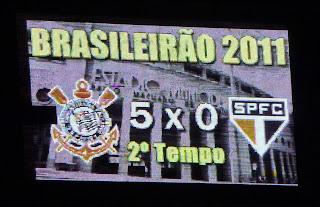
As for the game, it started tight but ended up being a complete blowout. Play of the game was a controversial red card against Sao Paulo late in the first period. It was 0-0 after the first half, but down a man, Sao Paulo was not even slightly competitive against the Corinthians in the second half. The first goal came maybe around the 55-60th minute, and from that point on it was complete domination. The game ended 5-0 Corinthians, who now sit atop the Brazilian football league standings. Big game indeed.

Here's a link to a few short videos that we took showing the big flags, first goal (caught randomly on camera), crowd reaction, and then some post-match signing and celebrating.


-----
*Since we're writing this from Brazil, it seems most appropriate in this post to refer to this sport as they do here in Brazil, and for that matter, essentially everywhere else in the world.